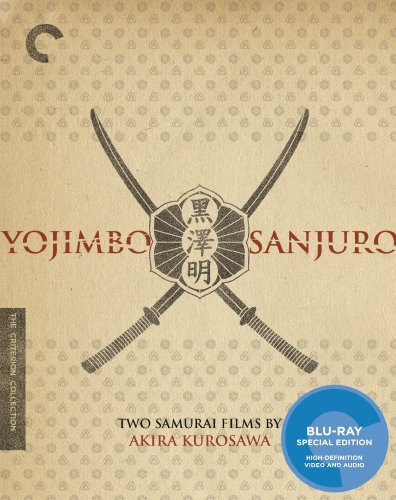
#1 Cheap Yojimbo & Sanjuro (Criterion Collection) [Blu-ray] Reviews
Special Price Today Go To Store!! (Limited Time Offer)
Akira Kurosawa made the best samurai movies in cinematic history, since he mixed in other elements (spaghetti westerns!) and crafted the action around the stories. And the two-movie pack of "Yojimbo" and "Sanjuro" is deeply satisfying -- vivid, compelling, often humorous and they star the fantastic Toshiro Mifune.
"Yojimbo" was an adaptation of Dashiell Hammett's "Red Harvest," the story of a detective who cleans up a city. But Kurosawa yanks the action across the world, to a grizzled samurai (Mifune) who wanders into an impoverished town, after hearing a farmer talking about the corruption there.
He wasn't kidding -- the nearby town is a battleground for two warring clans and the corrupt police. The samurai knows that he's smarter than anyone else in the town, so he starts playing the two clans against one another, while deftly sidestepping the inevitable clashes.
If "Yojimbo" is a dark comedy, "Sanjuro" is more of a straight-out comedy, with the return of Mifune's scruffy, wily hero. This time, he rescues nine naive, inept young noblemen from the Superintendent's thugs, and after figuring out the conspiracy that is forming in a nearby town, he decides to rescue the Superintendant, his wife and daughter.
Unfortunately, the samurai (now going by the name of Sanjuro Tsubaki) soon finds that the noblemen aren't very bright, and they also have a bad habit of disobeying him, since he is of lower rank than they are. He concocts a plan to thwart the Superintendant and his deadly lieutenant... assuming his army of nine doesn't botch it.
Kurosawa was a lover of American cowboy flicks, and at times this shows, especially in the rugged hero, who acts like a medieval Japanese gunslinger (he even has the piercing eyes for it). Mifune plays his character like a mellower version of a Clint Eastwood anti-hero, and it's got deserted streets, corrupt officials, frenetic attacks on the bad guys, and other fun tropes of the genre.
But first and foremost, these are solid stories, weaving together intricate conspiracies, manipulation, and some blood-spurting action sequences with flashing swords, Kurosawa's filmmaking is not quite flawless -- the dead have a tendency not to bleed (or they bleed too much) -- but for form it can't be beaten. Battle scenes have a flash-bang intensity, or the slow, building pressure of duels, and he knows when to defuse them with liberal amounts of humor ("Get back in the cupboard!").
Mifune is the ideal rogue samurai -- he's gritty, unpretentious, and laughs openly when he sees a bunch of bullies who are too afraid to actually fight. Kurosawa gives him more dimension in the second movie, where he is compared to an "unsheathed blade" and compares himself to one of the villains, because they are the same kind of person.
Criterion is putting this blu-ray two-pack out, so you know it's gonna be good stuff -- it's going to have fat booklets with essays, notes from Kurosawa's crew, galleries, behind-the-scenes stuff, trailers, and selected documentaries from some Kurosawa-centric series "Akira Kurosawa: It Is Wonderful to Create"... specifically, the ones involving THESE two movies. And they're being released on Kurosawa's 100th birthday... sweet.
For any rabid cinephile, Kurosawa's films are a must. Epic action movies with plenty of swords, comedy and grizzled heroes don't come any better than these.
Yojimbo & Sanjuro (Criterion Collection) [Blu-ray] Overview
Thanks to perhaps the most indelible character in Akira Kurosawa’s oeuvre, Yojimbo surpassed even Seven Samurai in popularity when it was released. The masterless samurai Sanjuro, who slyly manipulates two warring clans to his own advantage in a small, dusty village, was so entertainingly embodied by the brilliant Toshiro Mifune, that it was only a matter of time before he returned in a sequel. Made just one year later, Sanjuromatches Yojimbo’s storytelling dexterity, yet adds a layer of world-weary pragmatism that brings the duo to a thrilling and unforgettable conclusion.
Sanjuro: In Kurosawa’s sly companion piece to Yojimbo, the jaded samurai Sanjuro helps an idealistic group of young warriors weed out their clan’s evil influences, and in the process turns their image of a: proper, samurai on its ear.
Yojimbo: To rid a terror-stricken village of corruption, wily masterless samurai Sanjuro (Toshiro Mifune) turns a range war between two evil clans to his own advantage in Akira Kurosawa’s visually stunning and darkly comic Yojimbo.
Stills from Yojimbo
 |  |  |
Yojimbo & Sanjuro on Blu-ray - R.D. Monsoon -
This is a review of the Criterion Blu-ray release of Yojimbo & Sanjuro.
These are the first Blu-ray Criterion releases that I've been disappointed with. This isn't to say that the transfers are bad, but I feel that a better job could have been done.
With both films it looks like too much grain was removed. It's no where near as bad as the John Carpenter version of "The Thing" where there was so much noise reduction that it looks like someone airbrushed the film, but the crystal look of the transfers makes it look more like TV and less like a 35mm film. Compare it to Criterion's Blu-ray of "The Third Man" which is awash in beautiful grain.
The very hot, even harsh lighting in both films comes off as looking like someone boosted the the contrast way too high.
Finally, in some shots in "Sanjuro" it looks like a second generation negative was used -- these shots are soft and washed out.
Now, there are also a lot of good things about the Blu-rays. In both films Kurosawa takes full advantage of the large real estate cinemascope provided him. In "Yojimbo" there are many scenes where he pacts as many of the gang members into frame, and throughout Sanjuro the actors are meticulously blocked so that all nine samurai and Sanjuro appear in frame. These films were made to be seen on the big screen, not on TV. On DVD, even when watching on a large screen TV, between the low resolution and the compression, a lot of detail was lost on these kinds of wide and extreme wide shots. Thanks to the higher resolution of Blu-ray, even in the very large crowd shots of the gangs in "Yojimbo" you can see the expressions on all the faces. Blu-ray also handles Kurosawa's extreme depth of focus quite well. The shot in "Yojimbo" at the end with the old man hanging in the foreground, the gang in the middle of the street, and Sanjuro all the way in the distances looks fantastic -- it would make for a great still photograph.
So what does this all mean in terms of buying this set? The transfers are by no means a disaster, but as I think I made clear, could have been better. But this is probably the best we'll get for a while, and it's acceptable.

No comments:
Post a Comment