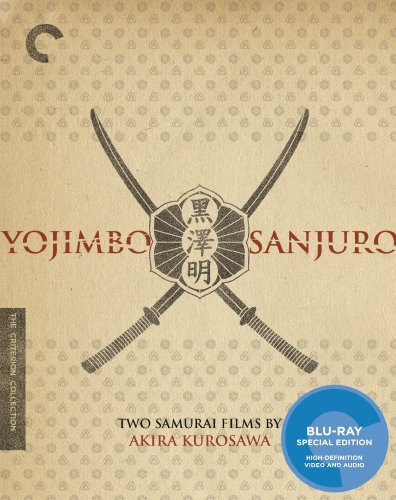
#1 Cheap Yojimbo & Sanjuro (Criterion Collection) [Blu-ray] Reviews
Available at Amazon Limited Special Price!! See Now!!
Iconic and Unforgettable. Two words that can best describe "YOJIMBO" (1961)--a tale of an alienated, scornful Ronin anti-hero, permanently inked into the pages of samurai history .
Arguably Kurosawa Akira's most famous film alongside with his other Jidai Geki masterpiece, "Seven Samurai". (But what about other forgotten films like "Sanshiro Sugata and "Stray Dog"?) First released in 1961, the film was a tremendous success and paved the way for other films in the samurai genre. The lead character played by Toshiro Mifune would become his most famous role and would invigorate the world of Japanese cinema with the emergence of other lone wolf swordsmen long before the blind swordsman Zatoichi started swinging his sword. "Yojimbo" also marks his reunion with cinematographer Miyagawa Kazuo; together the two had awed western audiences with their other masterpiece called "Rashomon" in the 1950`s. Akira Kurosawa's "Yojimbo" is also the inspiration for Sergio Leone's "Fistful of Dollars" and other "spaghetti westerns"--the Italians are forever in the debt of Japanese Jidai Geki films.
A wandering Ronin, comes across a small town where Sheido, a wealthy silk merchant who also controls a brothel and Ushitora, a rich sake brewer along with their gangs of cutthroats constantly battle for control of the town. A wimpy constable and a town mayor allows the two feuding gangs do as they want, and the townsfolk suffers from their constant fights. The wandering samurai displays his skill with a sword and it is rather obvious that the gang who secures his services would have the clear advantage. However, things wouldn't be so easy for Sheido and Ushitora, as the nameless samurai (later known as "Sanjuro Kuwabatake") has his own agenda and plays both sides against the other.
So just what is it that makes "Yojimbo" so awesome?
Well, Kurosawa and Miyagawa is a dream team of Japanese filmmaking. They both superbly complement each other's skill. The director has very meticulous set ups and Miyagawa excellently does a deep focus technique in camera work, a style where everything (the foreground and the background) stays in perfect focus; thereby complementing Kurosawa's rich, complex visuals. So just how important is this? It allowed for some very nice techniques that allowed certain subtle mini-scenes receive attention and careful exposition. This was displayed when tavern keeper Gonji (Eijiro Tono) gave the layout and power structures in this shabby little town by opening shutters to our wandering Sanjuro; individuals are shown in the sub-sections of the small wooden openings. It is a very useful device in compact storytelling, and manages to say a lot of things within a few quick and simple shots. A very methodical and meticulous style that revolutionized the way films were made.
Oh, I'm not done yet.
At the beginning of the film, the character of our wandering ronin is fully fleshed out in the first few minutes of the film. We see him with his back turned, Sanjuro shrugs his shoulders and scratches his head quite a lot because he is itchy and haven't bathe in awhile. When he thinks, he pulls his hand inside his kimono sleeve and touches his chin; a simple gesture to suggest that he is cunning, clandestine, stealthy and calculating. The move is a visual guide to his character, giving the viewer an idea as to what this unkempt samurai is all about. When Sanjuro comes to a fork on the road, he throws a stick in the air and goes to the direction where it points. A clear exposition of someone looking for purpose with no intended destination. These things are what made Kurosawa such a celebrated filmmaker, he makes you pay attention to his simple visuals and trains the viewer to read between the lines. Kurosawa had created a multi-layered lead character with so many dimensions, and I while we are almost certain that he is no defender of justice, we are privy to his own crisis of conscience.
Actor Toshiro Mifune always meshed well with Akira Kurosawa. Together they have made several unforgettable films that put them both on the map. I don't like to sound repetitive, but I always saw Mifune with a very strong charismatic presence onscreen. He has that personality that makes him "own" his role--his character just attains a certain dimension that gives the character life. Mifune had taken on less than stellar roles to support himself under less efficient directors because it takes Kurosawa time to put together a film. Mifune may not have a flawless resume but don't let those films be your cause to judge his skills as an actor.
Now let's break down the film's screenplay, characters and dialogue. The kindly tavern keeper, Gonji serves as the moral center of the film as he constantly lectures our wandering samurai that killing is wrong. Sanjuro says "..in this town, I'll get paid killing and this town is full of men who are better off dead". This simple sentence gives a lot of character development to the town itself and to our anti-hero. It demonstrates that Sanjuro himself is an opportunist and may well have only come to profit out of the town's disorder. But much to his own surprise, he finds himself slowly developing compassion as he befriends Gonji and becomes enraged when he hears the plight of the Kohei and Nui. Human nature and compassion are excellently played in its screenplay however powerful and at times subtle it may appear to be.
The screenplay is just so full of dark humor that makes the film truly enjoyable. It may have a lighter tone than other chambara films by Masaki Kobayashi but keep in mind that this film deals with the dealings of the common folk--farmers, peasants, ronins and the like. The film is full of metaphors that are excellently played at. Accompanied by the soundtrack by Masaru Sato, the film exudes a playful but percussive arrangement that fits the film's mood. The characters are given a life of their own and allowed room to develop in each frame. Tatsuya Nakadai (Hara-Kiri, Sword of Doom) also makes an appearance as Uno, the pistol-wielding sociopath brother of the sake merchant. This early pistol provides a cheapness to Ushitora's group, and meant as an ace in their sleeve--why use a gun when everyone else is holding a sword?
The film has some nicely choreographed bits of swordplay but it isn't anything too flashy or extravagant. The swordfights are quick and precise. This may not be Mifune's crowing moment in displaying his convincing display of skills with a katana but nonetheless, the fights are fun to watch. They are nothing elaborate but prove to be extensions of our protagonist and as a display of his resolve and righteous fury. In the film's final act you see the blowing sandstorm to initiate the final showdown and Kurosawa did this to further begin a somber mood (began after Sanjuro gets beaten), which begins to abandon its somewhat darkly humorous pace.
"Yojimbo" has massive western appeal and those unfamiliar with samurai films would be well advised to check out this title first. This is a pivotal film to the samurai genre and is a great introduction to samurai films. See epics like "Samurai Rebellion", Inagaki`s "Samurai Trilogy" and "Seven Samurai" when you are ready. "Yojimbo" is one hell of a masterpiece that will awaken your interest in samurai films.
HIGHEST POSSIBLE RECOMMENDATION! [5- Stars]
Video/Audio: 2.40 anamorphic widescreen. This Black and white Criterion re-mastered high definition transfer is exceptional. The film is very clean, radiant and full of contrast. The blacks are solid but maintains a grayish tone when needed. The re-mastered 3.0 Dolby Digital track is also impressive with the subtitles being well timed and well translated.
Yojimbo & Sanjuro (Criterion Collection) [Blu-ray] Overview
Thanks to perhaps the most indelible character in Akira Kurosawa’s oeuvre, YOJIMBO surpassed even Seven Samurai in popularity when it was released. The masterless samurai SANJURO, who slyly manipulates two warring clans to his own advantage in a small, dusty village, was so entertainingly embodied by the brilliant Toshiro Mifune, that it was only a matter of time before he returned in a sequel. Made just one year later, SANJURO matches YOJIMBO’s storytelling dexterity, yet adds a layer of world-weary pragmatism that brings the duo to a thrilling and unforgettable conclusion.
SANJURO: In Kurosawa’s sly companion piece to Yojimbo, the jaded samurai Sanjuro helps an idealistic group of young warriors weed out their clan’s evil influences, and in the process turns their image of a: proper, samurai on its ear.
YOJIMBO: To rid a terror-stricken village of corruption, wily masterless samurai Sanjuro (Toshiro Mifune) turns a range war between two evil clans to his own advantage in Akira Kurosawa’s visually stunning and darkly comic Yojimbo.
Wandering warrior - E. A Solinas - MD USA
Akira Kurosawa made the best samurai movies in cinematic history, since he mixed in other elements (spaghetti westerns!) and crafted the action around the stories. And the two-movie pack of "Yojimbo" and "Sanjuro" is deeply satisfying -- vivid, compelling, often humorous and they star the fantastic Toshiro Mifune.
"Yojimbo" was an adaptation of Dashiell Hammett's "Red Harvest," the story of a detective who cleans up a city. But Kurosawa yanks the action across the world, to a grizzled samurai (Mifune) who wanders into an impoverished town, after hearing a farmer talking about the corruption there.
He wasn't kidding -- the nearby town is a battleground for two warring clans and the corrupt police. The samurai knows that he's smarter than anyone else in the town, so he starts playing the two clans against one another, while deftly sidestepping the inevitable clashes.
If "Yojimbo" is a dark comedy, "Sanjuro" is more of a straight-out comedy, with the return of Mifune's scruffy, wily hero. This time, he rescues nine naive, inept young noblemen from the Superintendent's thugs, and after figuring out the conspiracy that is forming in a nearby town, he decides to rescue the Superintendant, his wife and daughter.
Unfortunately, the samurai (now going by the name of Sanjuro Tsubaki) soon finds that the noblemen aren't very bright, and they also have a bad habit of disobeying him, since he is of lower rank than they are. He concocts a plan to thwart the Superintendant and his deadly lieutenant... assuming his army of nine doesn't botch it.
Kurosawa was a lover of American cowboy flicks, and at times this shows, especially in the rugged hero, who acts like a medieval Japanese gunslinger (he even has the piercing eyes for it). Mifune plays his character like a mellower version of a Clint Eastwood anti-hero, and it's got deserted streets, corrupt officials, frenetic attacks on the bad guys, and other fun tropes of the genre.
But first and foremost, these are solid stories, weaving together intricate conspiracies, manipulation, and some blood-spurting action sequences with flashing swords, Kurosawa's filmmaking is not quite flawless -- the dead have a tendency not to bleed (or they bleed too much) -- but for form it can't be beaten. Battle scenes have a flash-bang intensity, or the slow, building pressure of duels, and he knows when to defuse them with liberal amounts of humor ("Get back in the cupboard!").
Mifune is the ideal rogue samurai -- he's gritty, unpretentious, and laughs openly when he sees a bunch of bullies who are too afraid to actually fight. Kurosawa gives him more dimension in the second movie, where he is compared to an "unsheathed blade" and compares himself to one of the villains, because they are the same kind of person.
Criterion is putting this blu-ray two-pack out, so you know it's gonna be good stuff -- it's going to have fat booklets with essays, notes from Kurosawa's crew, galleries, behind-the-scenes stuff, trailers, and selected documentaries from some Kurosawa-centric series "Akira Kurosawa: It Is Wonderful to Create"... specifically, the ones involving THESE two movies. And they're being released on Kurosawa's 100th birthday... sweet.
For any rabid cinephile, Kurosawa's films are a must. Epic action movies with plenty of swords, comedy and grizzled heroes don't come any better than these.

No comments:
Post a Comment